
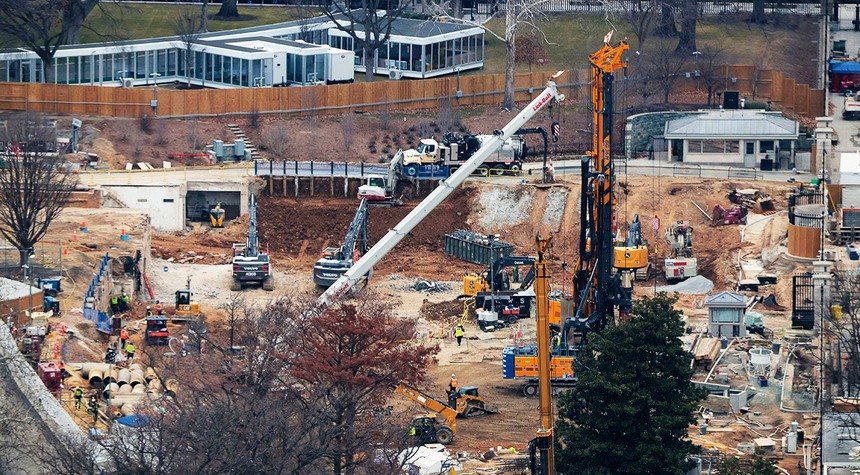
The question of who controls the People’s House has taken on new urgency as President Donald Trump faces a legal challenge over his ambitious plan to add a grand ballroom to the White House complex.
In a statement released Sunday, Trump made clear he has no intention of halting construction on the 90,000-square-foot ballroom, calling the lawsuit against the project both tardy and without merit. The president characterized the legal action, filed by the National Trust for Historic Preservation, as the work of “obstructionists and troublemakers” who waited until construction was already underway to raise their objections.
“Why didn’t these obstructionists and troublemakers bring their baseless lawsuit much earlier?” Trump questioned, making a point that resonates with anyone who has watched opponents of this administration employ delay tactics at every turn.
The facts of the matter deserve careful consideration. According to the president, this ballroom represents a $300 million gift to the American people, funded entirely through private donations rather than taxpayer dollars. That distinction matters in ways that should not be overlooked. In an era when government spending draws rightful scrutiny, a project of this magnitude proceeding without public funding represents a different proposition entirely.
The current White House lacks a formal ballroom, a deficiency that has long limited the executive mansion’s capacity to host state dinners and ceremonial functions befitting the world’s most powerful nation. The new facility will accommodate approximately 650 seated guests while maintaining the classical architectural style that has defined the White House since its construction.
Trump’s defense of the project rests partly on historical precedent. The East Wing, which the ballroom will replace, has undergone numerous modifications over the decades. As the president noted, the current structure “bore no resemblance or relationship to the original building.” That argument carries weight when considering that the White House has evolved continuously since John Adams first occupied it in 1800.
The ballroom project represents just one element of Trump’s broader vision for reshaping the physical landscape of American power. Since returning to office, the president has moved with characteristic speed to leave his mark on the nation’s most symbolic spaces.
Plans are moving forward for what Trump has dubbed the “Arc de Trump,” a monumental arch modeled after Paris’s Arc de Triomphe, intended to welcome visitors crossing the Arlington Memorial Bridge into the capital. The structure is planned to commemorate America’s 250th anniversary in 2026.
Inside the White House itself, Trump has already completed a gilded renovation of the Oval Office, adding gold accents to ceiling details, doorway trim, and even the cherubs adorning the door frames. The president reportedly covered these costs personally, reflecting his preference for opulence in the spaces where he conducts the nation’s business.
The administration has also installed the “Presidential Walk of Fame” along the West Wing colonnade, featuring portraits of past presidents in a display that connects current leadership to the broader sweep of American history.
Whether these projects represent appropriate stewardship of national symbols or an overreach of presidential authority remains a matter of legitimate debate. A federal judge has already raised questions about Trump’s authority to proceed with the ballroom construction, suggesting the legal challenge may have more substance than the president acknowledges.
What seems certain is that this dispute will not be resolved quickly or quietly. The collision between presidential ambition and institutional preservation raises fundamental questions about who decides how America’s most iconic buildings should evolve.
Related: Federal Judge Blocks Evidence Preservation in Minneapolis Border Patrol Shooting Case