
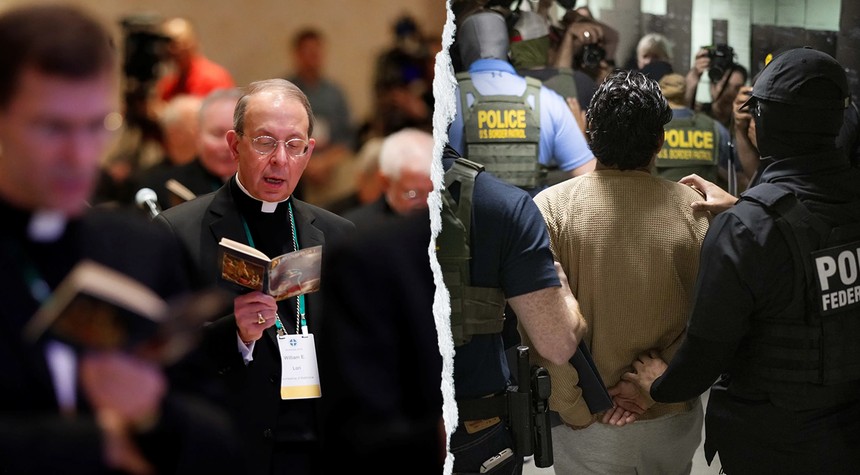
The debate over immigration enforcement has moved from the political arena into the pews, and it raises questions that go to the heart of what it means to balance compassion with the rule of law.
This week, the U.S. Conference of Catholic Bishops issued what they called a “special pastoral message on immigration,” declaring their opposition to what they termed “indiscriminate mass deportation of people.” The bishops expressed concern about a “climate of fear and anxiety” surrounding immigration enforcement and lamented conditions in detention centers.
But not everyone wearing a cross around their neck sees it the same way.
A day after the bishops made their statement, CatholicVote, a conservative advocacy group, fired back with a detailed report titled “Immigration Enforcement and the Christian Conscience.” The message was clear and direct: You can be a faithful Catholic and still support strong border enforcement, including physical barriers, detention, and yes, deportation.
Border czar Tom Homan did not mince words either, stating flatly that the Catholic Church is “wrong” on its immigration position. His argument carries weight that deserves consideration. Enforcing border laws, he maintains, actually saves lives.
The CatholicVote report makes a case that merits serious attention. While the bishops invoke scripture about caring for “the least of these,” the conservative group points out that this biblical mandate applies to all people, including Americans left unemployed, forgotten, or victimized by crime that weak border enforcement can enable.
Here is where the rubber meets the road. The report argues that policies presented as “humane” and “compassionate” often carry a terrible human toll. Weak borders and lenient enforcement enrich and empower criminal cartels, harming both Americans and the very migrants these policies claim to protect.
The bishops expressed grief over families separated by immigration enforcement. CatholicVote counters that deportations, even those resulting in family separation, serve a legitimate law enforcement purpose. The report suggests there is no essential difference between these separations and those that occur when any parent faces consequences for breaking the law.
This is not about lacking compassion. It is about recognizing that compassion without borders is not compassion at all. It is chaos dressed up in religious language.
The bishops spoke of immigrants who have “arbitrarily lost their legal status” and parents who fear taking their children to school. But the word “arbitrarily” does heavy lifting in that sentence. If someone entered the country illegally or overstayed a visa, the loss of legal status is not arbitrary. It is the consequence of violating immigration law.
CatholicVote argues that faithful Catholics can support strong immigration enforcement without violating church teaching. That statement challenges what some church leaders have suggested and opens up what the group calls “a more complete conversation on immigration.”
The question facing Catholics, and indeed all Americans, is whether enforcing the law can coexist with Christian charity. CatholicVote says yes. The bishops seem less certain.
What remains undeniable is this: The cartels are real. The victims of trafficking are real. The fentanyl deaths are real. The communities struggling with the costs of illegal immigration are real. These realities demand more than sentiment. They demand solutions rooted in both justice and mercy, law and compassion.
That balance has always been difficult to strike, but strike it we must.
Related: European Antifa Cells Face Foreign Terrorist Classification Alongside ISIS and Al-Qaeda