Chicago Teachers Union Pushes May Day Protests During School Hours
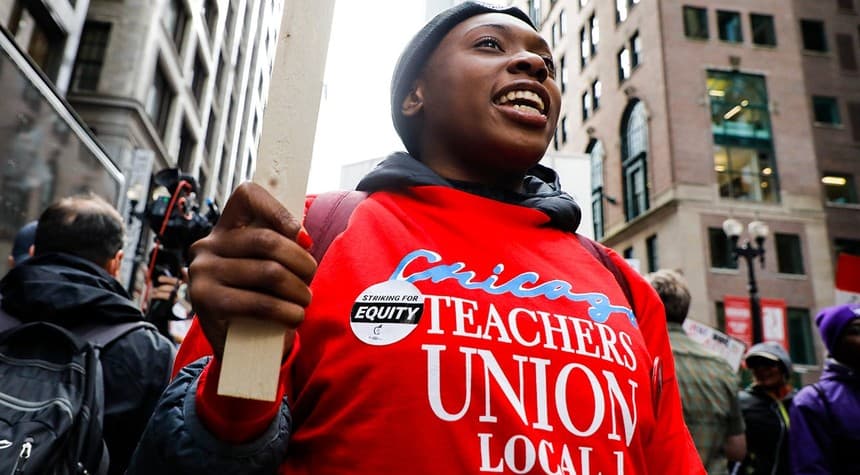
The Chicago Teachers Union has engineered what amounts to a politically charged field trip, and parents across the Windy City ought to be asking some hard questions about what exactly their tax dollars are funding.
Come May 1, Chicago Public Schools will remain officially open for instruction. But make no mistake about the message being sent when school administrators give students permission to abandon their desks for protest marches during regular school hours.
The union pushed through a resolution last month designating May 1, International Workers' Day, as a "Day of Civic Action and Defense of Public Education." The language sounds noble enough until you examine what lies beneath the surface. This is not about teaching civic responsibility or democratic participation. This is about mobilizing students as political foot soldiers.
Union Vice President Jackson Potter laid bare the real agenda in his statement, warning that democracy itself hangs in the balance and calling on "every Chicagoan to stand up" against what he termed "the authoritarian billionaire in Washington." The rhetoric drips with partisan fervor, and it raises a fundamental question: When did our public schools become organizing hubs for political movements?
Chicago Public Schools confirmed Friday that May 1 remains a full instructional day, with students and staff expected to attend. Yet in the same breath, the district announced that principals may allow "optional participation" in "civic engagement events" for students who wish to join protests during school hours.
Let that sink in for a moment. While hardworking parents assume their children are learning mathematics, science, and literature, school administrators will grant permission slips for political demonstrations.
The union's resolution specifically invokes May Day, a date with deep roots in international labor movements and, historically, communist celebrations worldwide. Whether one agrees or disagrees with labor organizing, the appropriation of instructional time for political activism represents a troubling erosion of educational boundaries.
Critics have warned that this initiative amounts to grooming students into political activism, transforming classrooms into recruitment centers for partisan causes. The concern is not theoretical. When schools officially sanction protest participation during the school day, they lend institutional authority to specific political viewpoints.
Parents send their children to school trusting that educators will teach critical thinking skills, not predetermined political conclusions. They expect their children will learn how to think, not what to think.
The Chicago Teachers Union has long positioned itself at the forefront of progressive educational activism. But there exists a vast difference between teachers exercising their First Amendment rights on their own time and using school hours and school resources to advance political agendas.
Schools should cultivate informed citizens capable of independent thought and civic participation. That noble goal becomes corrupted when administrators transform the school day into political theater, complete with officially sanctioned walkouts and protests.
The question facing Chicago parents is straightforward: Are their children receiving education or indoctrination? The answer may well be found in how many empty desks appear on May 1, and whether those absences represent genuine civic learning or something else entirely.
Democracy thrives on informed debate and civic participation. It withers when institutions entrusted with education abandon their core mission for political activism. Chicago's experiment with May Day protests during school hours may teach students something after all, just not the lesson educators claim to be offering.
Related: New Legislation Aims to Shield American Energy Producers from Retroactive Climate Penalties