
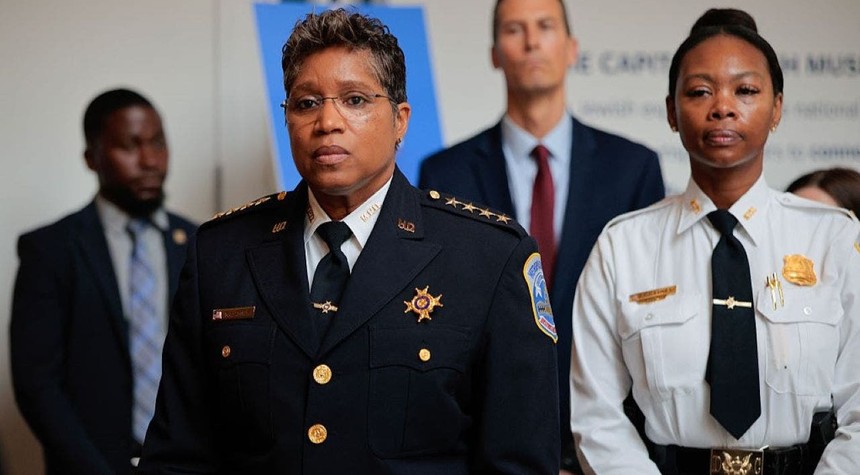
There is a familiar pattern in Washington when the heat gets too intense, and Monday brought us another chapter. Metropolitan Police Chief Pamela Smith announced her resignation after just two and a half years at the helm, stepping down amid mounting pressure from multiple directions.
The timing tells a story all its own. Smith’s departure comes as the Trump administration maintains federal oversight of the nation’s capital, deploying federal law enforcement throughout the city in response to concerns about public safety. When a police chief suddenly decides “it’s time,” as Smith put it, experienced observers know there is usually more to the story than meets the eye.
Smith struck a gracious tone in her public statement, thanking Mayor Muriel Bowser for the appointment and expressing gratitude for her time with the District. The mayor returned the sentiment, praising Smith for weathering what she called “attacks on our city’s autonomy.” Yet beneath these polite exchanges lies a more complicated reality.
The controversy surrounding Smith’s tenure runs deep. District residents have accused her department of cooperating with federal immigration enforcement, allegations she firmly denies. Smith maintains that her officers have not worked alongside immigration authorities, suggesting that social media videos showing federal agents operating in the city present only a partial picture of the situation.
More troubling are the allegations from within her own ranks. Roughly three dozen rank-and-file officers and detectives have filed complaints with the Justice Department, claiming that department leadership instructed them to reclassify serious crimes to make the city’s statistics appear more favorable. This is not a minor administrative dispute. We are talking about the potential manipulation of public safety data that citizens rely upon to understand the security of their neighborhoods.
According to these officers, the practice went on for months and in some cases years. Reports from the Southeast’s Seventh District alone allegedly contained as many as 150 potentially misclassified incidents. The fact that supervisors later upgraded charges in approximately half of these cases raises serious questions about the initial classifications.
Smith denied any wrongdoing on Monday, stating categorically that she never instructed anyone to alter statistics. Yet the sheer number of complaints from officers and the ongoing Justice Department investigation suggest this matter will not disappear with her resignation.
The situation in Washington represents a broader challenge facing American cities. When crime statistics become politicized, when the pressure to show improvement overrides the commitment to honest reporting, public trust erodes. Citizens deserve accurate information about public safety, and officers deserve leadership that supports honest reporting without fear of reprisal.
Smith’s departure leaves Washington’s police department at a crossroads. The next chief will inherit not only the day-to-day challenges of managing a major metropolitan force but also the task of restoring confidence both within the ranks and among the citizens they serve.
The question now is whether city leadership will use this transition to address the underlying issues or simply turn the page and hope the controversies fade. History suggests that problems ignored have a way of resurfacing, often at the most inconvenient moments.
Related: Death Threats Pour In After Idaho Saloon Offers Free Beer to Those Who Help ICE