The Department of Justice released a massive collection of files related to Jeffrey Epstein on Friday afternoon, and among the thousands of documents were photographs that raise serious questions about what powerful people knew and when they knew it.
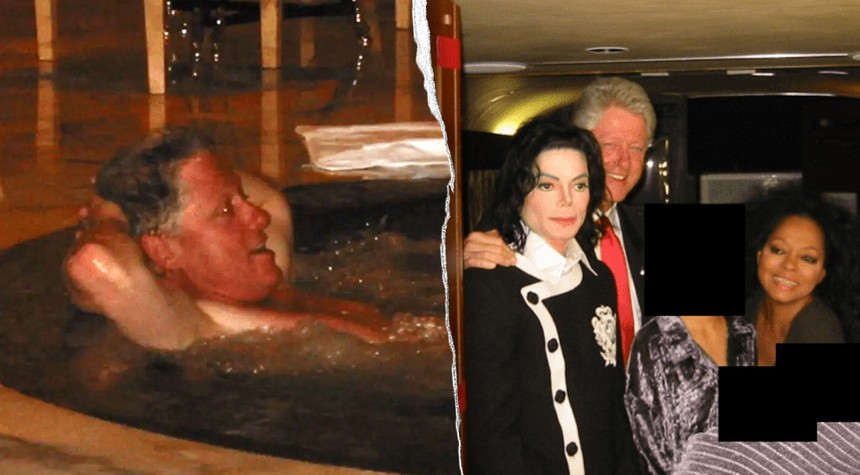
The images show former President Bill Clinton in compromising positions that demand explanation. One photograph captures Clinton topless in a dimly lit hot tub, arms folded behind his head in a posture of relaxation. Another shows him wading in a pool next to Ghislaine Maxwell, the British socialite now serving time in federal prison for her role in Epstein’s sex trafficking operation. A woman whose face was redacted by authorities stands nearby.
Additional photographs show Clinton posing with pop stars Michael Jackson and Diana Ross, seated on a plane next to a woman wearing an American flag pin whose identity was also concealed, and smiling arm-in-arm with Epstein himself at what appears to be a dinner party.
The timing of this document dump speaks volumes. Friday afternoon releases have long been the preferred method for burying news that someone hopes will not receive proper scrutiny. The locations where these photographs were taken remain unknown. No context was provided by the Justice Department.
White House deputy press secretary Abigail Jackson raised a point that deserves attention. The Epstein Files Transparency Act specifically instructed the Justice Department to redact only the faces of victims and minors. If that is true, then the identities being concealed in these photographs merit investigation.
The response from Clinton’s camp came swiftly. Angel Ureña, Clinton’s deputy chief of staff, attempted to redirect attention toward the current administration, suggesting the White House released these files to shield itself from future revelations. He drew a distinction between those who severed ties with Epstein before his crimes became public knowledge and those who maintained relationships afterward.
This defense raises as many questions as it answers. The American people deserve a full accounting of who knew what about Epstein’s activities and when they learned it. These photographs, grainy though some may be, represent pieces of a puzzle that has yet to be fully assembled.
The Justice Department’s decision to release thousands of documents on a Friday afternoon, when news coverage traditionally diminishes heading into the weekend, follows a pattern that has become all too familiar in Washington. When uncomfortable truths need to see the light of day but those in power hope to minimize their impact, the Friday afternoon document dump serves as the preferred vehicle.
Republicans have accused Democrats of selectively leaking documents to fabricate connections between political opponents and Epstein while downplaying others. Democrats have countered that the current administration is attempting to protect itself from scrutiny. Both sides may have valid points, but neither should be allowed to use partisan finger-pointing as a shield against legitimate inquiry.
The photographs themselves cannot be unseen. They exist as historical record, frozen moments in time that connect powerful individuals to a man whose crimes shocked the conscience of the nation. Whether these connections represent innocent social encounters or something more sinister remains to be determined through thorough investigation.
The American people have a right to know the full truth about who associated with Jeffrey Epstein, what they knew about his activities, and when they chose to distance themselves from him. Anything less than complete transparency dishonors the victims and undermines public trust in our institutions.
Related: Maria Shriver Condemns Kennedy Center Name Change as Board Votes Unanimously