
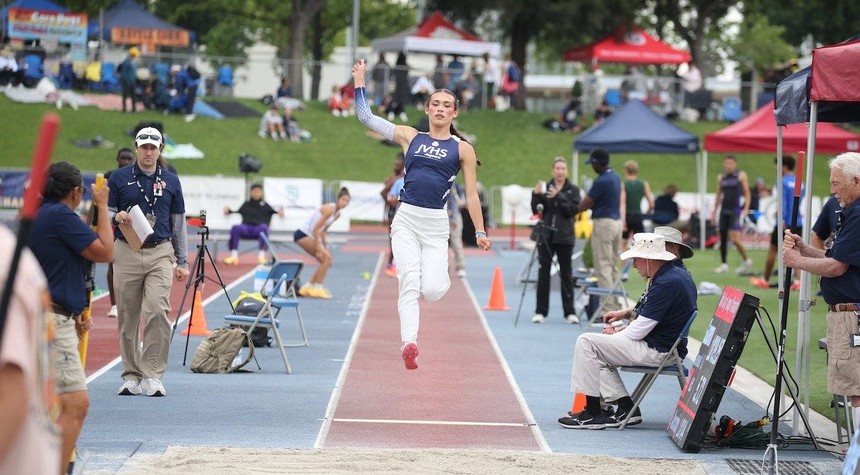
The question of fairness in women’s athletics moved from the theoretical to the all-too-real outside a high school track championship in California, where competing groups of activists turned a sporting event into a flashpoint that required police intervention.
The scene unfolded at the California Interscholastic Federation state championship in Clovis, where transgender athlete AB Hernandez competed in three girls’ jumping events. What began as an organized press conference quickly deteriorated into the kind of confrontation that has become increasingly common as Americans grapple with how to balance competing values and rights.
Local LGBTQ advocacy groups Pride at the Pier and Rainbow Families Action had arranged the press conference to show support for Hernandez. The athlete’s mother, Nereyda Hernandez, joined other activists in speaking on behalf of the competitor. It was, by all accounts, proceeding as planned until a group identifying as “Save Girls Sports” activists arrived on the scene.
The clash that followed was verbal but intense enough that Clovis Police Department officers, already stationed nearby, moved in to oversee the situation. Multiple patrol vehicles were visible as the shouting escalated between the two camps, each convinced of the righteousness of their cause.
This is the reality of where we find ourselves as a nation. High school track meets now require police presence not because of unruly fans or safety concerns related to the competition itself, but because the very question of who should compete has become so divisive that adults cannot gather in the same space without law enforcement standing ready.
The confrontation eventually subsided on its own without direct police intervention, though the Clovis Police Department declined to provide further comment on the incident. The silence from official channels speaks volumes about the sensitivity surrounding these matters and the difficulty local authorities face in navigating such charged situations.
What happened in Clovis represents more than just another protest. It reflects the deep fracture in how Americans view fairness, opportunity, and the purpose of sex-separated athletics. One side sees inclusion and affirmation as paramount values. The other sees biological advantages and the protection of opportunities for female athletes as non-negotiable principles.
Both groups showed up believing they were defending something important. The “Save Girls Sports” advocates argue that allowing biological males to compete in girls’ events undermines the very purpose of women’s athletics and creates unfair advantages that deny opportunities to female athletes. The LGBTQ activists counter that transgender youth deserve support and the right to participate in activities consistent with their gender identity.
The truth is that these confrontations will likely continue until Americans find common ground or until policy settles the matter one way or another. State legislatures across the country have taken varying approaches, with some banning transgender athletes from competing in sports that do not match their biological sex and others allowing such participation.
California has positioned itself firmly on one side of this debate, but as the scene in Clovis demonstrated, not all Californians agree with that position. The question remains whether we can have these difficult conversations without requiring police supervision, or whether every track meet and swimming competition will become another battleground in America’s ongoing culture wars.
Related: Trump Defends Giants Quarterback Jaxson Dart After Rally Appearance Draws Criticism