
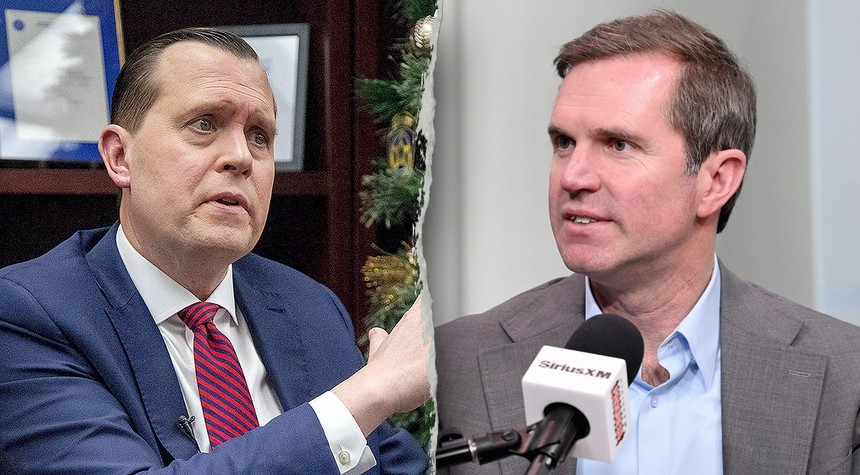
There are moments in governance when the fault lines between state officials crack wide open, revealing fundamental disagreements about law, order, and the safety of American communities. Kentucky finds itself at such a crossroads today.
Attorney General Russell Coleman has drawn a firm line in the sand against Governor Andy Beshear’s startling demand that Immigration and Customs Enforcement agents be pulled from every American city. The governor made his position clear during a recent appearance on a national talk show, calling for wholesale removal of ICE personnel and a complete reorganization of federal immigration enforcement.
“Every ICE agent should be withdrawn from every city and every community that they’re in. This organization has to be reformed from the top-down,” Beshear declared, adding that the current leadership should be terminated and every agent retrained. He invoked what he called the “body-count of American citizens” as justification for an immediate pause in operations.
Coleman, speaking from Daviess County where local law enforcement maintains active cooperation with federal immigration authorities, minced no words in his response. The attorney general, who has carried both a badge and prosecuted cases at the federal level, called the governor’s statement “absurd.”
“My view as the chief law enforcement officer of this commonwealth, someone that’s carried a badge and a gun, someone that has been a federal prosecutor, is that statement that the governor made was absurd,” Coleman stated plainly.
The dispute exposes a critical question about who controls what in Kentucky’s law enforcement apparatus. While the Kentucky State Police fall under the governor’s authority and currently cooperate with ICE, Coleman’s office works directly with the commonwealth’s 120 county sheriffs, many of whom maintain their own partnerships with the Department of Homeland Security.
Coleman made clear he has no intention of backing down. “I don’t want to set up a straw-dog argument because the reality is the collaboration is never going to stop here because those of us who have taken an oath to protect families are going to work with our federal partners,” he said.
The results of such cooperation speak for themselves. Recent joint operations across the Tug Fork River led to the arrests of 650 illegal immigrants in neighboring West Virginia, demonstrating the tangible outcomes of federal-state collaboration.
The legal landscape of this confrontation presents fascinating constitutional questions. Former federal prosecutor Zack Smith noted that while every state’s attorney general operates under slightly different parameters, both governors and sheriffs serve as elected constitutional officers. In most instances, neither can simply order the other around.
The attorney general can issue legal opinions and advisory guidance about state law requirements, but his direct authority over independently elected sheriffs remains limited in certain respects.
What makes this dispute particularly significant is its timing. As the nation grapples with immigration enforcement policy, Kentucky’s internal battle may preview similar conflicts in other states where elected officials find themselves on opposite sides of federal cooperation.
For Coleman, the issue transcends politics. He emphasized that his position reflects the views of the sheriffs and law enforcement officers he works with daily, men and women who have sworn oaths to protect their communities.
The question now is whether this disagreement remains rhetorical or escalates into an actual operational conflict. Can a governor who opposes ICE cooperation effectively hamstring those efforts when the attorney general, county sheriffs, and local law enforcement remain committed to working with federal authorities?
The answer may determine not just Kentucky’s approach to immigration enforcement, but establish precedents that reverberate across state lines. In the meantime, Coleman has made his position unmistakably clear: the collaboration will continue, regardless of the governor’s objections.
Related: Immigration Officers Turn to Face Coverings After Wave of Violent Threats