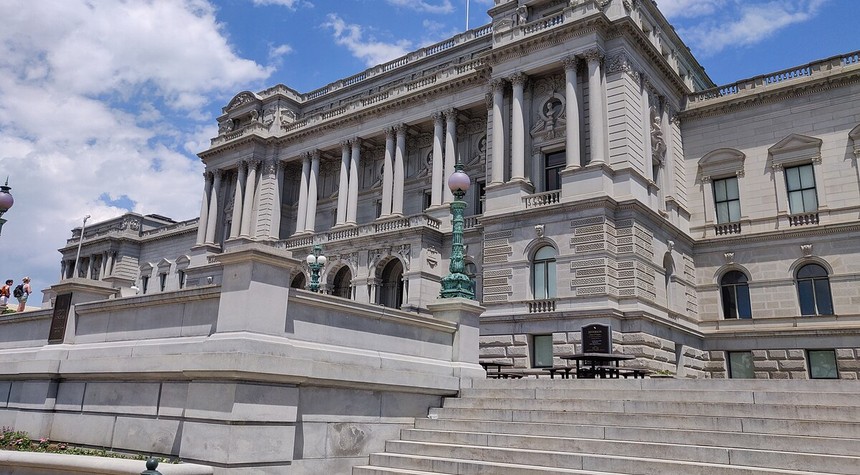
The Supreme Court has chosen to wait before wading into the murky waters of presidential firing power, at least when it comes to one particular case involving the Library of Congress.
On Wednesday, the high court issued a brief, one-page order that essentially kicked the can down the road on whether President Trump can remove Shira Perlmutter from her position leading the U.S. Copyright Office. The justices declined to immediately pause a lower court injunction that attempted to block her termination, which occurred back in May.
Now, before we get too deep into the legal weeds here, it is worth understanding what is really at stake. This case is not merely about one official’s employment status. It cuts to the very heart of how much authority a president has over the executive branch he was elected to lead.
Perlmutter’s removal came shortly after Trump dismissed Carla Hayden, an Obama appointee who had been serving as Librarian of Congress. Deputy Attorney General Todd Blanche has stepped in to fill that role on an acting basis. A three-judge panel on the D.C. Circuit Court of Appeals issued an injunction in September attempting to prevent the administration from completing Perlmutter’s dismissal.
Justice Clarence Thomas stood alone in indicating he would have granted the administration’s request to pause that injunction immediately. The other justices, however, decided to defer any decision until they resolve two other, more significant cases that address the same fundamental question.
Those cases involve Trump’s firing of Rebecca Slaughter from the Federal Trade Commission and Lisa Cook from the Federal Reserve Board of Governors. Both are Democrat appointees, and both cases have resulted in lower court judges attempting to prevent their removals.
The Supreme Court has already agreed to hear oral arguments in the Slaughter case this coming December, and arguments in the Cook case are scheduled for January 2026. The justices have specifically asked the parties to address whether statutory removal protections for commission members violate the separation of powers doctrine enshrined in the Constitution.
Here is where things get particularly interesting. The court has also asked whether a 1935 decision known as Humphrey’s Executor should be overruled. That nearly century-old ruling gave birth to what has become known as the “administrative state,” a sprawling network of so-called independent agencies that operate with remarkable autonomy from presidential oversight.
For decades, this arrangement has allowed unelected bureaucrats to wield enormous power while insulated from the accountability that comes with democratic elections. The theory behind these independent agencies was born during the Progressive Era, when faith in expert technocrats ran high and skepticism of executive authority was fashionable in certain circles.
The Trump administration’s position is straightforward: The president is elected to lead the executive branch, and he cannot effectively do so if he lacks the authority to remove officials who are not carrying out his directives. The counterargument holds that certain positions require independence from political pressure to function properly.
The Supreme Court’s decision to bundle these cases together suggests the justices recognize they are dealing with questions that extend far beyond individual personnel disputes. They are grappling with the fundamental structure of American government and whether nearly a century of administrative state expansion can be reconciled with the Constitution’s clear design.
The court’s reluctance to act immediately in the Perlmutter case makes practical sense. Why rule piecemeal on the same core issue when larger cases addressing the identical constitutional questions are already on the docket?
The answers that emerge from these cases could reshape the balance of power in Washington for generations to come. Stay tuned.
Related: Hegseth Defends Lethal Strikes Against Cartel Operations as Lawful Military Action