
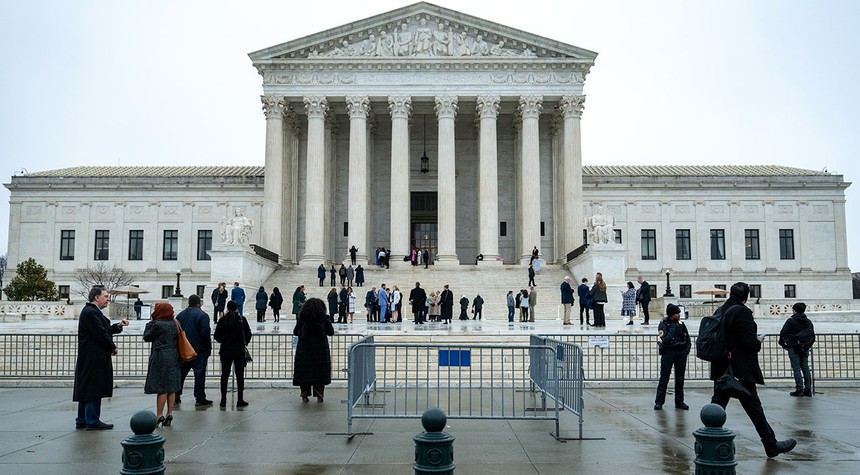
The Supreme Court handed Republicans a significant victory Monday, striking down a lower court ruling that had blocked Texas from implementing its redrawn congressional district maps. The decision marks another chapter in the increasingly contentious battles over redistricting that have erupted across the nation.
Make no mistake, this ruling carries weight far beyond the Lone Star State. The court’s decision, while brief, rested on precedent established in Abbott v. League of United Latin American Citizens. The justices offered little additional explanation for their reasoning, leaving legal observers to parse the implications.
The three liberal justices on the bench, Sonia Sotomayor, Elena Kagan, and Ketanji Brown Jackson, dissented from the majority opinion. Their opposition underscores the deep divisions over how congressional districts should be drawn and who gets to make those decisions.
This latest development follows the court’s December decision to temporarily greenlight Texas’ proposed map. That earlier ruling suggested which way the wind was blowing, and Monday’s order confirmed it. The pattern became even clearer when the court approved California’s redistricting map in February, handing Democrats a similar advantage in their state.
The political calculus here is worth examining. Texas’ approved map gives Republicans an estimated five-seat advantage in congressional races. California’s map provides Democrats with roughly the same boost. In effect, these two redistricting battles have largely canceled each other out on the national stage, though the implications for voters in those states remain substantial.
What we are witnessing is the emergence of mid-cycle redistricting as a new political battlefield. Texas and California pioneered these efforts, and now similar fights are cropping up across the country like wildflowers after a spring rain. States that once waited for the traditional decennial census cycle are now exploring whether they can redraw their maps more frequently.
The legal questions surrounding these redistricting efforts cut to the heart of representative democracy. Who draws the lines matters enormously. Those lines determine which communities vote together, which voices get amplified, and ultimately, which party controls the House of Representatives.
The Supreme Court’s willingness to allow these mid-cycle redistricting plans represents a significant shift in how electoral maps may be handled going forward. For decades, redistricting occurred primarily after each census, providing a measure of stability and predictability. That tradition appears to be eroding.
Republicans celebrated Monday’s ruling as an affirmation of state sovereignty and legislative authority. The decision allows Texas lawmakers to implement their vision for the state’s congressional representation without further delay. Democrats, meanwhile, view the ruling as another example of partisan gerrymandering that dilutes voter influence.
The dissenting justices’ opposition suggests this issue is far from settled in the court of public opinion, even if the legal question has been decided for now. As more states consider similar mid-cycle redistricting efforts, expect these battles to intensify rather than fade away.
The stakes could hardly be higher. Control of Congress often hinges on a handful of seats, and redistricting can swing those margins significantly. What happens in Texas and California today may well determine the political landscape for years to come.
Related: Liberal Nonprofits Circle Wagons Around Southern Poverty Law Center Facing Federal Prosecution