Bernie Sanders Calls CBS Part of American Oligarchy While Appearing on CBS
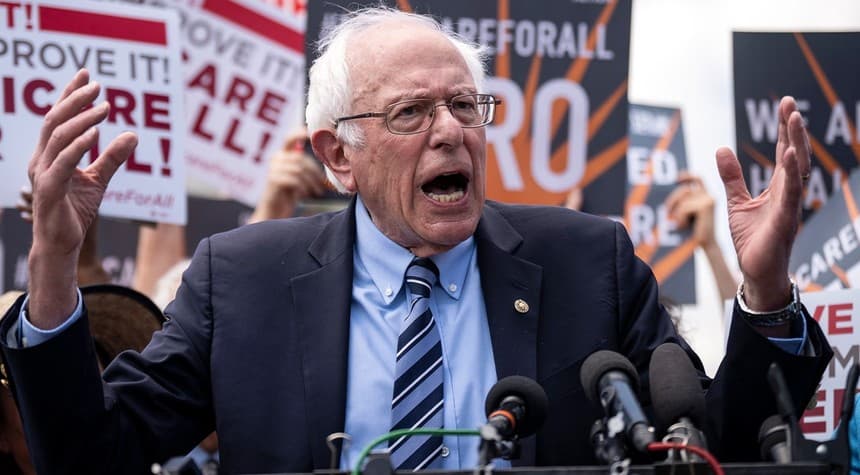
Courage. That is what it takes to walk into the lion's den and call out the lion while the cameras are rolling.
Senator Bernie Sanders of Vermont did precisely that Tuesday evening when he appeared on a major network's late-night program and proceeded to label that very network as part of what he termed America's growing oligarchy. The irony was not lost on observers, though whether it registered with the studio audience remains an open question.
During his appearance on the late-night broadcast, the independent senator from Vermont was asked to define oligarchy for viewers. His response cut straight to the bone.
"An oligarchy is a nation where a small number of incredibly wealthy people control the economy, control media," Sanders explained before delivering the kicker. "We have some experience with that right here on CBS."
The statement hung in the air like smoke from a just-fired pistol. Here sat a United States senator, on network television, calling out his hosts for being part of the very problem he has spent decades railing against.
Sanders did not stop there. He painted a picture of economic inequality that would make even the most hardened capitalist pause. According to the senator, the top one percent of Americans now own more wealth than the bottom ninety-three percent. He singled out one individual as owning more wealth than the bottom fifty-two percent of American households combined.
The senator's critique extended beyond mere wealth accumulation. He connected the dots between economic power and political influence, pointing to what he described as a corrupt political system enabled by Supreme Court decisions that opened the floodgates for unlimited political spending. He cited specific examples of billionaires spending hundreds of millions to influence presidential elections.
To his credit, Sanders did not limit his criticism to one side of the political aisle. He acknowledged that wealthy donors across the political spectrum participate in what he characterized as a pay-to-play system.
But the senator reserved particular concern for media consolidation. He noted the increasing concentration of media ownership, specifically mentioning that a tech billionaire now owns the network and its parent company. The implication was clear: when a handful of individuals control the platforms through which Americans receive their news and information, the marketplace of ideas becomes dangerously narrow.
The broader question Sanders raised deserves serious consideration, regardless of one's political leanings. When media companies consolidate under the ownership of a shrinking number of billionaires, does the public interest get served? When the same individuals who benefit from certain political outcomes also control major news outlets and social media platforms, can we trust the information we receive?
These are not partisan questions. They strike at the heart of what makes a democratic republic function. A free press requires independence. Independence requires diversity of ownership. When that diversity disappears, so too does a crucial check on power.
Whether one agrees with Sanders' socialist-leaning politics or not, his willingness to speak this truth in such an unlikely venue demonstrates a certain consistency. The senator has been beating this drum for decades, long before it became fashionable in certain circles to worry about billionaire influence.
The real test will be whether anyone was listening, or whether the message got lost in the entertainment.
Related: New Bill Would Strip Citizenship From Naturalized Americans Who Commit Fraud or Felonies