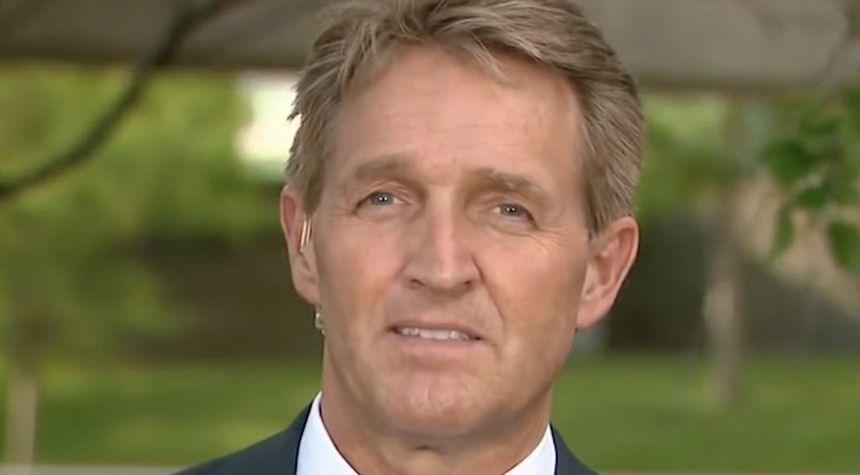
The courage of conviction, or perhaps the luxury of political retirement, has a way of loosening tongues in Washington. Former Arizona Senator Jeff Flake, once a Republican standard-bearer in the Grand Canyon State, delivered a pointed assessment this week that ought to give the current administration pause.
Speaking on national television, Flake pulled no punches in his evaluation of President Donald Trump’s handling of economic messaging, particularly regarding the affordability crisis gripping American households from coast to coast.
“The president may not want to talk about the affordability crisis, but he’s going to have to,” Flake stated plainly. His words carry the weight of someone who has walked the political tightrope and understands the precarious nature of voter sentiment when wallets grow thin.
The former senator took particular issue with recent claims that prices have declined across the board, calling such assertions fundamentally disconnected from the reality Americans face at grocery stores, gas stations, and shopping centers nationwide. “The notion that prices are down everywhere, they really aren’t and people know that,” Flake observed, drawing a direct parallel to the challenges Democrats faced in the 2024 election cycle.
Here is where the analysis becomes particularly interesting. Flake noted that while President Trump himself has demonstrated an almost unprecedented ability to weather political storms that would sink other politicians, those who attempt to replicate his approach rarely achieve similar success.
Arizona serves as his primary exhibit. Despite being characterized as a red state, the Grand Canyon State now boasts a Democratic governor, two Democratic senators, and Democratic officials holding the positions of attorney general and secretary of state. According to Flake, this political transformation stems directly from Republicans who tried to imitate Trump’s style without his particular political alchemy.
The former senator predicts what he terms “a great migration” within Republican ranks, a movement he insists has already begun and will accelerate as economic realities clash with current messaging strategies. His specific concern centers on tariff policy, which he describes as inherently inflationary, a position he characterizes as a fundamental Republican principle being abandoned or ignored.
“Tariffs are inflationary. That is a Republican article of faith,” Flake emphasized, suggesting that many Republicans will eventually return to what he called “the new, old ground, where we used to reside.”
Whether Flake’s predictions prove accurate remains to be seen. Political forecasting is notoriously unreliable, particularly in an era when traditional rules seem to bend and break with regularity. However, his warning touches on a genuine vulnerability: the disconnect between official pronouncements and lived experience.
Americans know what they pay for eggs, milk, and gasoline. They understand their household budgets better than any economist or politician. When leaders insist that economic conditions differ from what citizens experience daily, credibility erodes quickly.
The question facing Republicans is whether Flake represents a canary in the coal mine or simply a voice from the political wilderness, disconnected from the party’s current direction. Time, as it always does, will provide the answer.
Related: Senate Republicans Stand With Trump on Venezuelan Drug Boat Strikes