
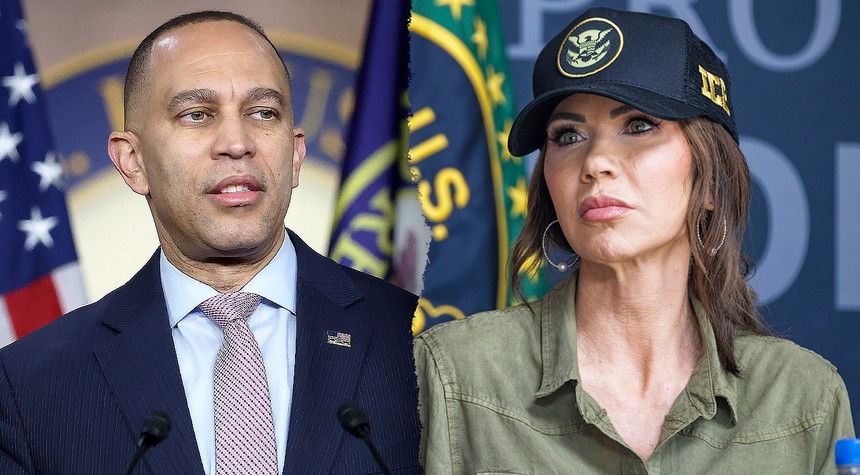
The political standoff over Department of Homeland Security funding has taken a sharp turn, and it appears the divide between Republicans and Democrats has grown wider than the Rio Grande itself.
House Minority Leader Hakeem Jeffries made clear this week that Democrats will not be satisfied with half measures when it comes to the Republican-proposed funding bill for DHS. Speaking to reporters Wednesday, the New York congressman dismissed the possibility that Secretary Kristi Noem’s removal from office would be sufficient to secure Democratic support for the legislation.
“Noem being fired or removed from office is, of course, not enough,” Jeffries stated plainly. He added that such a move would be merely “a start” in the right direction.
The Democratic leader’s comments reveal the depth of opposition his party harbors toward the current state of homeland security operations. In remarks that will undoubtedly raise eyebrows across the political spectrum, Jeffries referred to the Department of Homeland Security as a “killing machine,” language that signals just how far apart the two parties stand on immigration enforcement and border security policy.
When pressed on what specific changes would need to be made to the funding bill for Democrats to come to the table, Jeffries declined to provide concrete details beyond his assessment that removing the secretary would be insufficient. This lack of specificity may prove frustrating to Republicans seeking to find common ground and avoid a funding crisis.
The standoff comes at a critical juncture for the Department of Homeland Security, which requires congressional appropriations to maintain operations. Without a funding agreement, the agency faces potential disruptions to its various missions, from border security to cybersecurity operations and disaster response.
Secretary Noem has been a lightning rod for controversy since taking the helm at DHS. Her approach to immigration enforcement and border security has drawn praise from conservatives who believe in strict enforcement of immigration laws, while simultaneously drawing fierce criticism from progressives who view current policies as excessively harsh.
The question now becomes whether Republicans will be willing to negotiate substantive changes to their proposed funding bill, or whether they will hold firm on their current approach. With Democrats controlling enough votes to potentially block the measure, compromise may prove necessary.
However, Jeffries’ characterization of the department as a “killing machine” suggests that Democratic demands may extend far beyond personnel changes. Such inflammatory rhetoric indicates that fundamental policy disagreements, rather than administrative concerns, lie at the heart of this dispute.
As this funding battle unfolds, American citizens watching from home might wonder whether their elected representatives can find a path forward that secures the homeland while respecting the values both parties claim to uphold. The coming weeks will test whether Washington can govern effectively in divided times, or whether partisan gridlock will once again carry the day.
One thing remains certain: Secretary Noem’s job security has become a bargaining chip in a much larger game, and the stakes involve nothing less than how America approaches border security and immigration enforcement in the years ahead.
Related: Fetterman Calls Abolish ICE Movement Stupid and Outrageous