President Honors Army Helicopter Pilot Shot During Operation to Capture Maduro
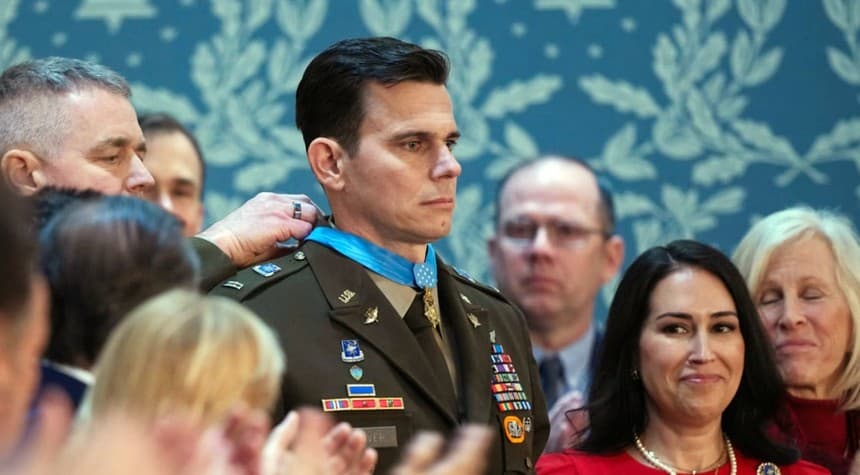
Courage, it has been said, is not the absence of fear but the mastery of it. And on Tuesday night, Americans witnessed something rare in our modern era—a warrior still bearing fresh wounds from battle, honored before the entire nation for extraordinary valor that unfolded mere weeks ago.
Chief Warrant Officer Eric Slover stood in the House gallery during President Trump's State of the Union address, his leg still healing from multiple gunshot wounds sustained during a classified operation in Caracas on January 3rd. There, before a joint session of Congress and millions watching at home, he received the Medal of Honor, our nation's highest military decoration.
The speed of this recognition is itself remarkable. While many Medal of Honor recipients wait years, even decades, for their service to be fully recognized, Slover's award came just seven weeks after the mission that earned it. The contrast was made all the more striking by the presence of another honoree that evening—100-year-old retired Navy fighter pilot Royce Williams, who waited more than 73 years to receive his Medal of Honor for combat in the Korean War.
The details of Slover's mission read like something from a thriller, yet they are all too real. The 45-year-old Army pilot flew the lead helicopter in a high-stakes operation to capture Venezuelan President Nicolas Maduro and his wife in the heart of Caracas. As Slover attempted to land his Army Chinook helicopter to deploy U.S. commandos, Venezuelan security forces opened fire.
"The success of the entire mission and the lives of his fellow warriors hinged on Eric's ability to take searing pain," President Trump told the assembled lawmakers and guests. Despite his wounds, Slover maneuvered his aircraft to protect the lives aboard while his gunners eliminated the threat.
The president's decision to present these medals during the State of the Union, rather than in the traditional White House ceremony, was unconventional. But it served a purpose—allowing the nation to witness these acts of heroism in real time, connecting Americans to the sacrifices made in their name.
Trump's address included several such moments designed to honor service and celebrate American achievement. He surprised a Venezuelan woman in the audience by revealing that her uncle, a political prisoner under the Maduro regime, had been freed and was present in the chamber. The emotional reunion drew sustained applause from both sides of the aisle.
The president also welcomed the U.S. hockey team, whose members filed into the House chamber to chants of "U-S-A" from lawmakers. Goalie Connor Hellebuyck received the Presidential Medal of Freedom, the highest civilian honor.
Yet it was Slover's recognition that carried particular weight. Here was a man whose identity had been shielded from public view less than two months prior as he prepared for a covert mission. Now he stood before the nation, still recovering from serious wounds, as Army Lt. Gen. Jonathan Braga placed the Medal of Honor around his neck.
His wife Amy watched from nearby, a reminder that valor in combat often comes with a price paid not just by the warrior, but by those who wait at home.
In an age when military operations often unfold in shadows, when special forces conduct missions the public learns about only in fragments if at all, this moment of public recognition served as a bridge between the classified world of special operations and the citizens those operators serve.
The ceremony honored not just individual courage, but the continuing tradition of American service across generations—from Williams's dogfights over Korea to Slover's helicopter under fire in Caracas, separated by seven decades but united by uncommon valor.
Related: Vance Gives Walz 60 Days to Address Medicaid Fraud in Minnesota