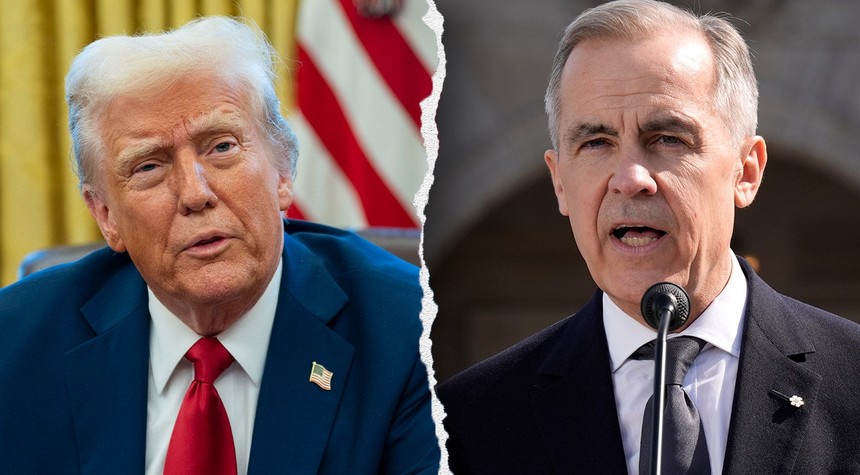
The halls of Congress witnessed something unusual Wednesday, the kind of political split that makes you sit up and take notice. Six House Republicans crossed the aisle to join Democrats in passing legislation aimed at reversing President Donald Trump’s emergency declaration at the northern border, a declaration that underpins his tariff policy against Canada.
The final tally stood at 219-211, a narrow margin that speaks volumes about the delicate balance of power and principle at play in Washington these days.
The Republicans who broke ranks deserve to be named: Representatives Dan Newhouse of Washington, Kevin Kiley of California, Don Bacon of Nebraska, Jeff Hurd of Colorado, and Brian Fitzpatrick of Pennsylvania. In a twist that demonstrates how tariffs cut across traditional party lines, Democrat Jared Golden of Maine voted with the Republican majority against the measure.
Democrats employed what is known as a privileged resolution to force this vote, a parliamentary maneuver that bypasses the objections of House leadership. It is a rarely used tool, but effective when the minority party believes it has found a crack in the majority’s armor.
As the vote teetered on the edge of success, President Trump took to Truth Social with a warning that carried the unmistakable weight of political consequence. “Any Republican, in the House or the Senate, that votes against TARIFFS will seriously suffer the consequences come Election time, and that includes Primaries,” the president wrote.
The defecting Republicans offered their reasoning, and it merits consideration. Representative Kiley pointed to the National Emergencies Act, which requires Congress to evaluate every six months whether an emergency still exists. “Canada has now significantly cracked down on fentanyl, so there’s no basis to extend the emergency another six months,” Kiley explained.
Representative Hurd took a broader constitutional view, one that reaches beyond the immediate political moment. “Article I gives Congress the authority to regulate commerce with foreign nations and to levy tariffs,” he stated. “Over time, Congress has delegated limited authority to the Executive Branch, particularly in matters involving national emergencies. But those delegations were never intended to serve as a permanent vehicle for sweeping, long-term trade policy.”
Hurd’s argument carries weight in conservative constitutional circles. He warned against normalizing broad emergency trade powers, noting that a future president of either party could wield the same authority in ways many would oppose. “The Constitution does not shift depending on who occupies the White House,” he said.
Meanwhile, Treasury Secretary Scott Bessent has been making the rounds defending the administration’s tariff strategy, arguing that Americans should prepare for an economic boom. The administration maintains that the tariffs are necessary leverage in dealing with both Canada and the larger issue of Chinese goods flowing through the northern border.
This vote represents more than a policy dispute. It illuminates the tension between executive authority and congressional prerogative, between party loyalty and constitutional principle. Whether these six Republicans face consequences in future primaries, as the president suggested, remains to be seen. What is certain is that this vote will be remembered as a moment when some chose constitutional concerns over political expediency.
The legislation now moves to the Senate, where its fate remains uncertain.
Related: Attorney General Pam Bondi Faces Tough Questions on Epstein Files and DOJ Restructuring