Small Nuclear Reactor Flies from California to Utah as Part of Energy Independence Push
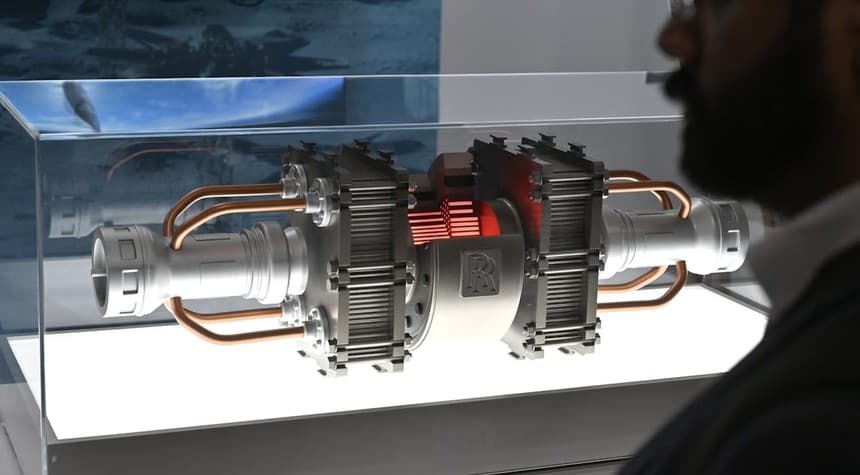
Courage, it has been said, is doing what needs to be done even when the path forward is uncertain. On Sunday, the United States took a bold step into uncharted territory when federal officials loaded a small nuclear reactor onto a military cargo plane and flew it across the American West.
This was not some routine transfer of equipment. This was the first time in our nation's history that a nuclear reactor, albeit one without fuel, had been transported by air. The C-17 aircraft carried the Ward microreactor from California to Hill Air Force Base in Utah, with Energy Secretary Chris Wright and Under Secretary of Defense Michael Duffey aboard to witness what they are calling a breakthrough moment.
The reactor itself is hardly larger than a minivan, yet it packs the potential to generate up to five megawatts of electricity, enough to power approximately 5,000 homes. The technology comes from Valar Atomics, a California-based company working to prove that nuclear power can be portable, deployable, and practical for both military operations and civilian needs in remote locations.
"This gets us closer to deploy nuclear power when and where it is needed to give our nation's warfighters the tools to win in battle," Duffey stated, making clear the strategic military implications of this technology.
The demonstration fits squarely within the Trump administration's broader vision for American energy independence and dominance. Last May, President Trump signed four executive orders designed to accelerate domestic nuclear deployment, recognizing that the nation's growing energy demands, particularly for national security and artificial intelligence development, require bold solutions. The Energy Department has backed up that commitment with grants issued in December to speed development of small modular reactors.
Proponents of this technology see microreactors as game-changers for military bases, disaster zones, and isolated communities that currently depend on diesel generators requiring constant fuel deliveries. The promise is clear: self-sustaining power that can be deployed rapidly wherever needed.
But as with any emerging technology, skeptics are raising hard questions about economic viability. Edwin Lyman, director of nuclear power safety at the Union of Concerned Scientists, has argued bluntly that microreactors lack a viable business model and will produce electricity at costs far exceeding both large nuclear plants and renewable sources like wind and solar.
The proof, as they say, will be in the pudding. Energy Secretary Wright has set an ambitious target: three microreactors reaching criticality, the point where nuclear reactions become self-sustaining, by July 4th. The reactor from Sunday's flight is scheduled to begin operating in July at 100 kilowatts, with plans to reach 250 kilowatts this year before eventually ramping up to its full five-megawatt capacity.
Valar CEO Isaiah Taylor has indicated his company hopes to begin selling power on a test basis soon, putting real-world performance data behind the promises.
The stakes here extend beyond mere electricity generation. In an era where energy security increasingly means national security, and where America's technological leadership depends on reliable power sources, the ability to deploy nuclear reactors quickly and safely could prove decisive. Whether on forward military bases, in disaster response scenarios, or supporting critical infrastructure in remote locations, portable nuclear power represents a capability that could reshape strategic calculations.
The question now is whether the technology can deliver on its promise at a price point that makes sense. Sunday's flight was a successful demonstration of logistics and engineering. The harder test lies ahead: proving these microreactors can operate safely, reliably, and economically in the real world.
Related: Secretary Noem’s Border Focus Creates Friction Within Coast Guard Ranks