Trump Calls Democrats Crazy After They Refuse to Stand for Parental Rights on Gender Issues
There are moments in political theater that cut through the usual Washington noise and reveal something fundamental about where we stand as a nation. Tuesday night's State of the Union address delivered one of those moments, and the reaction tells us plenty about the fault lines running through American politics today.
President Donald Trump took aim at Democrats during his address, calling them "crazy" after they remained seated while he demanded a ban on transitioning minors without parental consent. The response from everyday Americans, measured in real time by a live voter panel, painted a picture as divided as the chamber itself.
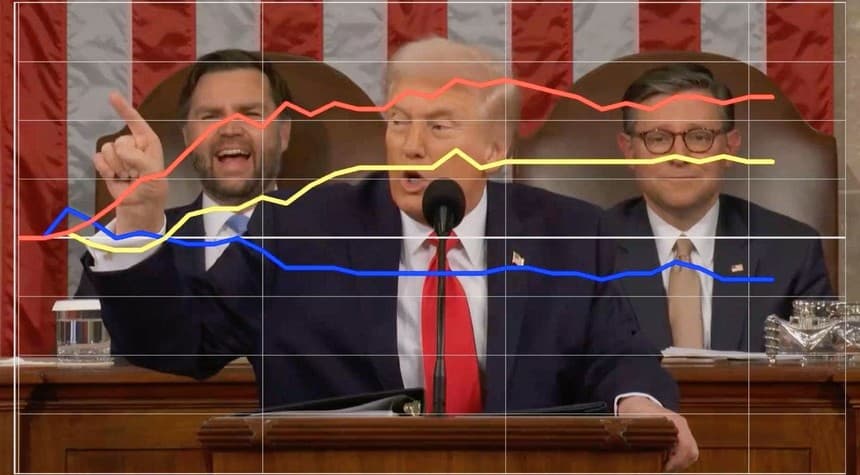
A polling group assembled 99 voters for the occasion: 29 Democrats, 30 Independents, and 40 Republicans. Their reactions were tracked moment by moment, displayed as colored lines on a graph that rose and fell with their approval or disapproval.
"But surely we can all agree no state can be allowed to rip children from their parents' arms and transition them to a new gender against the parents' will," Trump declared. "Who would believe that? We must ban it, and we must ban it immediately."
The Republican line shot upward into strongly positive territory. Independents ticked upward as well. Democrats moved in the opposite direction, their responses turning negative.
Then came the moment that sparked Trump's rebuke. Republicans in the chamber stood and applauded. Democrats did not.
"Look, nobody stands up," Trump said, his frustration evident. "These people are crazy. I'm telling you. They're crazy." He pointed directly at Democratic senators and House members who remained in their seats.
The voter panel's reactions held steady through this exchange. Republicans stayed elevated in their approval. Democrats remained negative. Independents held relatively steady, neither strongly approving nor disapproving.
This was not abstract policy debate. Trump had invited Sage Blair, a Virginia teenager, to sit in the gallery. Her family has filed legal action over what they describe as school policies that allowed gender transition discussions without parental knowledge or consent. Her presence gave the issue a human face, a real family dealing with real consequences.
The question of parental rights in education has become one of the defining issues separating the two major parties. What one side views as protecting children's autonomy and safety, the other sees as government overreach that undermines the fundamental role of parents in raising their children.
The polling data from Tuesday night suggests this divide extends well beyond the halls of Congress. It runs through neighborhoods, workplaces, and dinner tables across America. Republicans and Democrats are not just disagreeing on policy details. They are operating from fundamentally different premises about the role of parents, schools, and government in children's lives.
Independent voters, often seen as the persuadable middle in American politics, showed modest support for Trump's position. That may prove significant as both parties look toward future elections and try to win over voters not firmly committed to either side.
The State of the Union address is supposed to be a moment of national unity, a chance for the president to speak to all Americans regardless of party. Tuesday night showed how difficult that has become on certain issues. The applause lines that energize one side provoke stony silence from the other. The policies that seem like common sense to some Americans strike others as dangerous overreach.
This is where we are as a country. The graph lines tell the story as clearly as any speech could.
Related: Trump Administration Removes Federal Judge’s Pick for US Attorney in Virginia